Wednesday, October 6, 2010

It's All About FUN!


I just couldn't resist adding this little gem! 
I've titled my composition, "My Vibe." 
Press the large arrow and enjoy!

As Norman  posits, "Technology should bring more to our lives than the improved performance of tasks: it should add richness and enjoyment." (2004, p. 101) I was able to compose the above little tune on KissTunes,  an application that encourages pure fun! I agree wholeheartedly with Norman regarding the idea that information and/or tasks do not have to be presented or performed in a dreary, boring manner. Why not add elements of amusement and fun, pleasure and delight? To continue the musical theme here, watch this video clip created by FunTheory.com, which  is "dedicated to the thought that something as simple as fun is the easiest way to change people’s behaviour for the better. Be it for yourself, for the environment, or for something entirely different, the only thing that matters is that it’s change for the better."


Now this may seem an over-the-top example, but bear with me! Imagine that you have been asked to develop an innovative product that encourages people to make healthier choices in their day to day lives. What could be more practical, and, equally as important, fun? By including the 'fun' component to the provision of the 'healthy' staircase, we have included a motivating factor in its development.  One aspect of successful product utilization is whether it continues to be used after the initial novelty has worn off. Adding fun and motivation may allow that to happen.
Norman continues, 
"Beauty, fun, and pleasure all work together to produce enjoyment, a state of positive effect...which trigger many benefits....They are essential to people's curiosity and ability to learn." (p. 103) 

As a teacher, I am always on the look out for products that combine utility, usability, and 'fun' as they pertain to a particular teaching concept, skill, or activity. For example, this penguin metronome was a hit on all measures. My students were certainly motivated to learn and apply concepts around tempo and beat, as well as attend to various Italian, musical terminology! 

Dr. Stuart Brown, in his book, Play: How it Shapes the Brain, Opens the Imagination, and Invigorates the Soul (2010) states that play, "...is intensely pleasurable....It energizes us and enlivens us. It eases our burdens. It renews our natural sense of optimism and opens us up to new possibilities." (p. 4)

I recently witnessed the power of music to elicit a response at all three levels of processing (visceral, behavioral, and reflective), as my grandson, Rory, responded to several of my musical toys. He was immediately transformed to another state of being:  attentively listening, unconsciously dancing to the rhythms, and later returning, pointing and laughing, for a repeat of the experience! Of course, the fact that they were dancing and singing dogs may have played a part! 

Conversely, I am continually in 'discord' with my mobile phone which, without provocation, has decided to play a creative and somewhat annoying interpretation  of Beethoven's Fifth, instead of its normal ring-tone. My husband and I are mystified, as this is a recent phenomena. Sadly, as Norman points out, 
"much of our electronic equipment now bleats forth unthinking, unmusical sounds...the result is a cacophony of irksome beeps or otherwise unsettling sounds, sometimes useful, but mostly emotionally upsetting, jarring, and annoying." (p. 120)

Certainly, as my project group moves into creating a prototype, I will be very conscious  and cautious toward the addition of any sound components! Equally, I will be an advocate for motivational and/or pure fun aspects for our product. Both, however, need careful consideration and sensitive and sensible application. We need to incorporate these elements, together with attractiveness of design, in order to promote a healthy mix of response from the user(s): visceral, behavioral, and reflective.

So, on reflection, maybe it's not so uncomplicated  and simple to say, "It's All About FUN?"

Sunday, October 3, 2010

Universal Design...for the Shower?

My Shampoo and Conditioner!

"Universal design, designing for everyone, is a challenge, but one well worth the effort...there is no excuse not to design usable products that everyone can use." 
 Emotional Design, Norman (p.78)

My shampoo and conditioner are just a lighthearted example of 'Universal Design' in action!

There was once a time when I did not need to wear glasses to read anything, let alone the writing on a shampoo or conditioner product! However, over time this has become more and more of a challenge. As you can imagine, it is not exactly convenient to wear your glasses in the shower which has led to many difficulties in reading the labels on such products to find out which is the shampoo and which is the conditioner! Believe me, I have tried many brands but most have almost identical shaped containers, display similar colors and images, and have the identical method and lid design for extracting their contents. Many a time I have washed my hair in conditioner before I realize my mistake. Or, I have soaked the bathroom floor, as I open the shower door to reach for my glasses! 

Then...innovation! Modification! A design for all who have trouble seeing! Look carefully at the above products and you will notice that they are still almost identical in bottle shape, color and decorative image, and believe me, still hard to distinguish by their individual titles. However, a simple modification has been made that helps enormously-the lid for one is at the top and the lid for the other is at the bottom! Easy to feel and understand even without my glasses! A simple design change that means so much to the user.

This speaks somewhat to Behavioral Design for Norman, who states:

"...everyday things have to be used by a wide variety of people: short and tall, athletic and not, who speak and read different languages, who may be deaf or blind, or lack physical mobility or agility-or even hands." (p.78) 

Norman, however, does admit that usability is a complicated topic and requires a dedicated application of the principles of universal human-centered design.  

For Vicente:

"...we design technology that's tailored to our knowledge of the human factors that govern our behavior." (p.60) ..."we don't realize that our apparent shortcomings aren't necessarily signs of human frailty...the problem is that technology hasn't been designed to fit our bodies..." (p.66)


Being finicky about what seem to be small details in design may be all that makes the difference  between a somewhat successful adoption and universal usage and appeal. More importantly, it may prevent people berating themselves for 'errors' or seeming 'inabilities' in the face of day to day interactions with tools and objects in their world.


Every context needs its own Universal Design...for the Shower!

Saturday, October 2, 2010

Variety of Users, Needs, Preferences, and Motivators!

Colourful Army by Maistora
 As   Donald A. Norman states in Emotional Design, "With the large range of individual, cultural, and physical differences among the people of the world, it is impossible for a single product to satisfy everyone." (p. 41) 

During the interactive design process attention is given to fulfilling a human or societal need via a suitable and novel or modified technological solution. An interactive designer may pay great attention to assessment and observation of particular user(s) needs and preferences in different and natural contexts. As well, this iterative process may utilize appropriate focus groups, questionnaires, and interviews to generate feedback and assessment of the innovative and/or interactive product.  Much user testing and reworking of prototypes may have been conducted. (Interaction Design by Preece, Sharp, and Rogers) 

Consideration is also given, hopefully, and design modifications made, to cater to physical and psychological human factors, explored and illustrated by  Vicente  as steps in his hierarchical Human-Tech Ladder. (The Human Factor: p.61)

However, as the opening quote implies, satisfying all users may be easier aimed for, with the best of intentions, than done! There are many factors that may confound user acceptance of the final product, such as:
  • the final product design may have unexpected or undiscovered drawbacks or flaws
  • the final product design may appeal to users for emotional rather than, or in addition to, practical reasons
  • the final product may only function well in a particular and unique context 
  • the final product may offend a person's feelings of challenge and accomplishment  
For Donald A. Norman, much of the unexpected outcomes, lack of success, or negativity toward a product may be simply a function of what he terms Emotional Design. In the following recorded presentation, he briefly introduces this idea and explains about three intersecting levels of emotion and cognition; visceral, behavioral, and reflective.


Reading both Emotional Design by Norman and The Human Factor by Vicente have made me more conscious of the objects I interact with on a daily basis. Now, I ask myself, "Why do you like/dislike this? What's so appealing or not? Does this work the way it was intended?"  and so on!

For example, I have a favorite spoon and a favorite mug, neither of which belong to the kitchenware sets that we own! I feel so much better facing the day when I am able to use these objects for morning coffee and cereal: the day never feels the same otherwise...I am less 'in tune' with the world and less energized. 

Why? Norman would say that I have an emotional connection to these items:

Visceral, because  I respond to how pleasing they are to look at: the mug has a cute image and text (Git up and go!) and the spoon has the perfect bowl shape and a brushed silver texture!
Behavioral, because both items serve their intended purpose with class!  
Reflective, because I feel my day is 
incomplete and less perfect without them!


To close then, interactive design is influenced by many factors or variables which may be very challenging to accommodate for. Despite the best of a well thought out plan and creation, each end user will bring their own needs and wants, cultural and personality preferences, and to top it all off, unanticipated emotional reactions, to the final design. 

Let's embrace then, a Variety of Users

Tuesday, September 28, 2010

Is This Broken or Is This Design Broken?

   Seth Godin at Gel 2006 from Gel Conference on Vimeo.

The title of the above presentation was actually, This Is Broken, and according to the explanatory text asks, " Why are so many things broken?" and then, "Seth Godin gives a tour of things poorly designed, the 7 reasons why they are that way, and how to fix them." 

This is a very amusing look around our shared environment with the focus on whether  innovations within it help or hinder our day to day lives. 

Essentially, Seth Godin is highlighting some of the aspects and concerns of Interaction Design, defined by Preece, Rogers, and Sharp as "designing interactive products to support the way people communicate and interact in their everyday and working lives." (Preface)

This means that objects or technologies that have been designed for use in some fashion in our world should have decent functionality for the human user and, as Vicente states, "should focus on the physical and the non-physical aspects of the system." (p.24) For Vicente, results can be, and sometimes are, catastrophic:

"More and more, we're being asked to live with technology that is technically reliable, because it was created to fit our knowledge of the physical world., but that is so complex or so counterintuitive that it's actually unusable by most human beings." (p.17)

As I watched the above movie clip, I was often reminded of the usability goals as outlined in the Preece, Rogers, and Sharp text. 
For instance, several of the sign examples were obviously not effective, as they confused vital information with spurious information so that the reader could not see the essential text. 


The airport information sign was not efficient in providing speedy and important information to the traveler


The cup holder design for the car suggests several safety and utility issues!


The video thus provides some simple examples of what Vicente says are "unrealistic assumptions about human beings, creating a bad fit between people and technology." (p.44)

Listen to Kim Vicente discussing, The Human Factor


Hence my blog title for this posting points to the design process as broken as opposed to the item itself !

Is This Broken or Is This Design Broken? You tell me!

Monday, September 27, 2010

Usability! Usability! Usability!


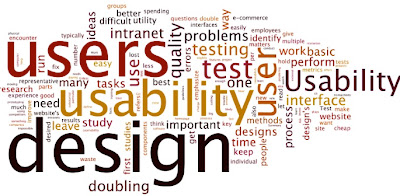
{This Wordle or word cloud was created from the text at Usability 101 by Jakob Nielsen }

The word cloud above serves to remind that usability of any innovation is paramount: words that occur frequently in a text, and imply importance, are seen clearly!  Interestingly, the word design jumps out at you with words connected to the user bearing down! 

Significant I think! 

It affirms the words by Robert Wright that Vicente includes in the opening pages of, The Human Factor:

"Your brain may give birth to any technology, but other brains will decide whether the technology thrives. The number of possible technologies is infinite, and only a few pass this test of affinity with human nature."

Line Up by Logan Brumm
 I was reminded of this concept recently on a visit to the Chinook Movie Theaters, here in Calgary. My family rarely go out to see movies these days due to in-home convenience, but this was a special occasion and we looked forward to dining out and seeing a new release!


And then we experienced the automatic ticket vending machines which are placed almost immediately at the top of the escalators. I'm sure on a non-new-release-night this necessary process and technology runs very smoothly. 


However, this wasn't one of those nights!

There seemed to be hundreds of bodies milling around, trying to attach themselves to a ticket queue, but more people kept plopping  from the top of the escalator and immediately affixing themselves to the ever growing lineup, which was gradually working its clumsy way DOWN the escalator! I think the egg in this picture expresses our dilemma very well!. We were all in jeopardy! Needless to say, the ticket machines also seemed to think this and several immediately protested at the hustle, bustle, and non-to-pleasant comments...they too became overloaded and quit! The machines kindly suggested we line up to use a different machine! Hardly conducive to a pleasant and worry free experience!

Essentially, the designers and creators of this environment and its technological gadgetry had not, it seems, fully considered the human factor. For example, much observation of people in the natural setting may have led to  possible experiences of varying traffic pattern fluctuations. This knowledge could then have been applied, say, to the placement of items. As well, product mock-ups that could demonstrate what happens when more people than expected try to use the technology would have allowed for iterative design of the ticket machine technology.

What did we do?
We went home and played board games...much more accessible!

Usability? Usability? Usability?You bet!

Under Digital Pressure


{Click on the link to go to this map at MindMeister.
 Choose an item to explore on the web.  
 Add your own digital ideas too!} 


After all of the reflection on my teaching practise and experience, I sum up my current predicament as experiencing digital pressure: my previous ideas had hardly identified a focus on using instructional design to incorporate technological ideas, objects or processes. Thankfully, I was drawn to, and accepted into, a collaborative group that immediately identified various technological innovations that we could design and use to prepare children, situated on the autistic disorder spectrum, to better cope with stressful social and emotional situations. An inspiring and positive outlook! This actually closely resembled my poorly articulated first thoughts around demystifying certain situations for English Language Learners. 

However, having found a somewhat like-minded group does not in itself alleviate the digital pressure: I and we are inundated with new and evolving technologies - daily it seems! The never ending quest to catch up, be current, be hip, close the digital divide, multi-task, multi-think, and become multi-competent in multi-digital contexts, is exhausting and exhilarating at the same time! The image above is an attempt to visualize and realize the participatory digital world that Dr. Jacobsen describes in, Teaching in a Participatory Digital World. Please visit the map and add your own digital connections! 

Dr. Jacobsen rightly states that, 
"Teachers... are now expected to embrace online participatory learning technologies in support of active, passion-based learning by students who live and work in a digital world." 

"Expected" is a well chosen word: for teachers, this implies a huge investment of extra time, resources, and often personal expense, and yet there is an assumption that by saying it will be...it will be! I agree that teachers, myself included, need more effective, timely, and realistic support in order to affect practice: indeed, my very presence in this graduate program is an attempt to improve my understanding, skills, and approach to this collaborative and digital teaching and learning landscape. Given that many  of these contexts remain ill equipped with hardware and/or access to adequate technologies, I am encouraged that the learning design and process remains paramount as, "active participation in knowledge construction allows for deeper conceptual understanding of disciplinary concepts and increased motivation for learning." (Dr.Jacobsen)

I liken the emphasis on peer collaboration, inquiry, problem solving, designing of meaningful and great tasks, and individual and peer evaluation, to the current reality in the world of work. My husband is experiencing a shift in how project planning is carried out in the software development environment: "Agile" planning requires attending to emergent needs, a focus on timely, specific tasks, constant review, revision, and continual contact with the user. In fact, I was surprised to find this development process explained in the text, Interaction Design, by Sharp, Rogers, and Preece. I had never heard of it before my husband's recent involvement with it. 

And so, to rise from under digital pressure, my newly formed team will be "Agile" and meet in a "Scrum" to review what we have already done, define what we will do today, and uncover any blockers to our "Sprint" project goals. 

By the way... I just added to our group wiki! 
I'm scrambling my way out from under, "Digital Pressure!"

Monday, September 20, 2010

On Second Thoughts!

 {Click link and type in 'perspectives.' TagGalaxy will load images. Click on Sun and watch!}

Perspectives in TagGalaxy 

Then again... I read and re-read Dr. Michele Jacobsen's article, Teaching in a Participatory Digital World and examined several of the project ideas suggested in the course outline for EDER 679.27.  Reflection on my teaching experiences in designing and actualizing Multiple Literacies projects inspired a different problem proposal:
  • How could I design a collaborative learning/inquiry experience for, say, Grades 5/6, in which multiple literacies/perspectives are encompassed, choice of learning path is provided, and motivating and varied technologies are used as appropriate to a variety of tasks?
  • How will I motivate students to be engaged and absorbed in their learning?
  • How might I design a student centered project, that provides for the uncovering of certain curriculum and/or skills and/or attitudes which also respects student diversity and individual emotional/social/physical/learning needs?
  • How might such a project allow for ongoing assessment and evaluation by each student, peer group, and teacher?
  • How could I provide for different end points and encompass choice in final presentations/projects that would allow for feelings and expressions of accomplishment? Would sharing with the rest of the school/world be appropriate or a choice students make?
  • What type of teaching and learning environment would support success for all? Blended?
  • How might this project encourage the use of appropriate and inspiring digital tools for each stage of defined tasks?
This initial proposal should involve several subject discipline areas with explorations of real world experiences and/or applications. The major goal is to promote and understand multiple ways of looking, thinking, learning, and sharing about our world.

Is this progress?
Will others be interested in this proposal?
Or is this just Second Thoughts?